Africa's AI Imperative: Shifting from Consumption to Production
As the global race for artificial intelligence intensifies, Africa faces a critical decision regarding its technological future. Dr. Mohamed H'MIDOUCHE, an economist and former international banker, recently published a significant contribution in the pan-African media outlet financialafrik.com, urging the continent to move beyond its role as a mere consumer of imported technologies. His call to action coincides with key financial and health discussions taking place in Brazzaville, emphasizing the urgency for Africa to become a co-producer of technological know-how, a guardian of sovereign data, and a leader in the new algorithmic economy.
Financial and Health Context in Brazzaville
Dr. H'MIDOUCHE's strategic insights come at a pivotal moment for the continent's geopolitics. From May 25 to 29, 2026, Brazzaville is hosting the annual meetings of the African Development Bank (AfDB) Group. Under the new presidency of Dr. Sidi Ould Tah, a primary focus of these financial discussions is the large-scale mobilization of development financing. Concurrently, Central Africa is grappling with a sensitive health emergency: the resurgence of the Ebola virus (Bundibugyo strain) in the Democratic Republic of Congo and Uganda, as reported by the WHO in May 2026.
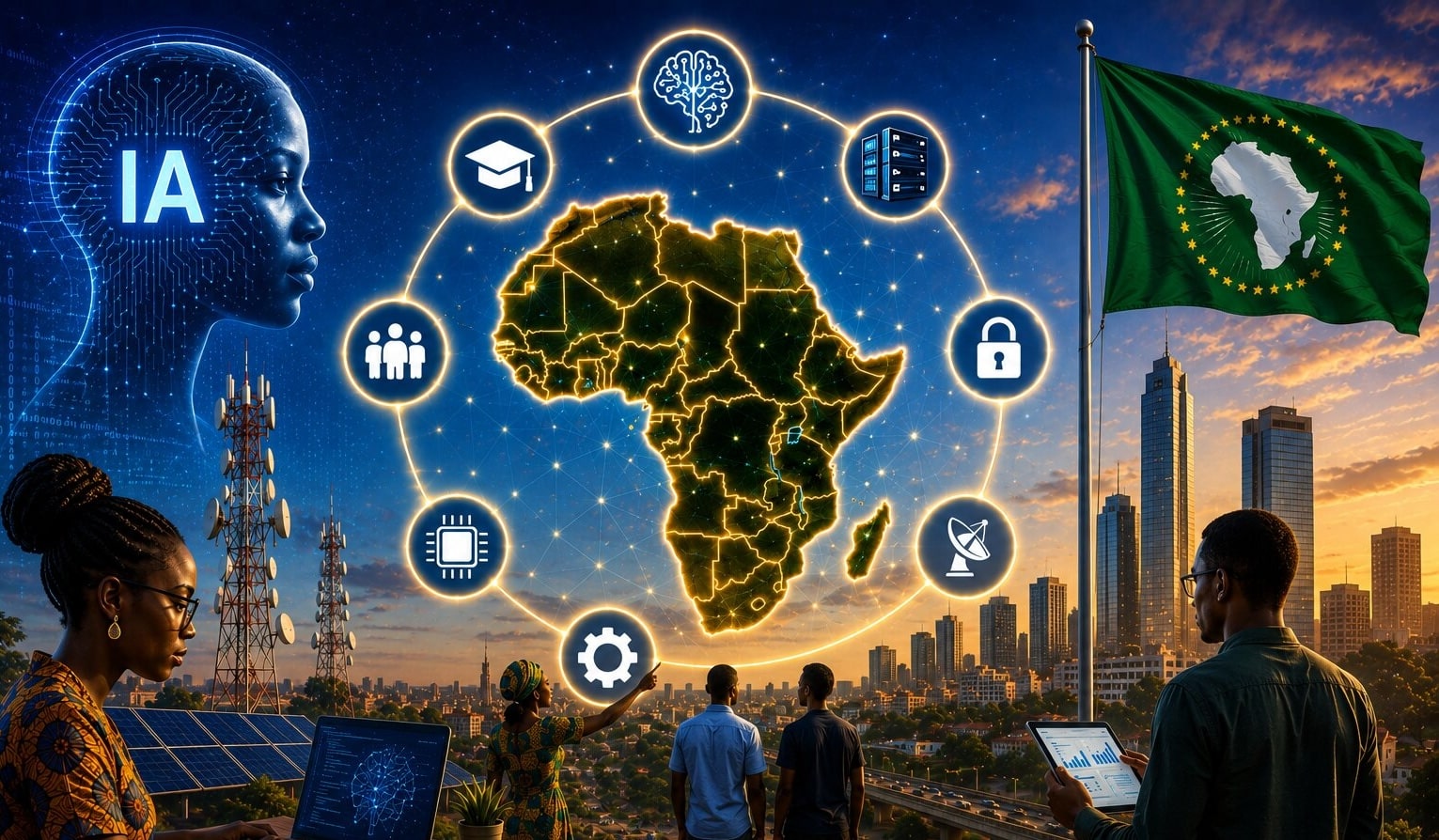
For Dr. H'MIDOUCHE, these dual challenges underscore that artificial intelligence, drones, data centers, and early warning systems are no longer peripheral technological tools. Instead, they represent critical infrastructure for prevention, resilience, and state sovereignty. Traditional research and development (R&D) is being reconfigured around cloud computing, cybersecurity, and computational power, with AI serving as the central intelligence of this new era where raw data is the planet's most coveted resource.
The Illusion of Western Investment and the Employment Paradox
Globally, the AI battle is characterized by massive investments. Dr. H'MIDOUCHE cites the American "Stargate" project—backed by OpenAI, SoftBank, and Oracle—which plans to invest up to $500 billion over four years. Stanford's AI Index 2025 report further confirms this dominance, quantifying private American investment at $109.1 billion in the past year, nearly twelve times the Chinese level.
However, Dr. H'MIDOUCHE cautions Africa about the social paradoxes of this revolution. Companies like Amazon and Microsoft are investing heavily in AI while simultaneously eliminating tens of thousands of corporate jobs. To navigate the algorithmic era wisely, Africa must direct AI towards productivity and social inclusion. Fortunately, the continent is not starting from scratch. The African Union adopted its Continental Artificial Intelligence Strategy in 2024, aligned with Agenda 2063, and countries such as Morocco, Egypt, Rwanda, Kenya, Nigeria, South Africa, Benin, and Côte d'Ivoire are already developing robust ecosystems. Yet, Dr. H'MIDOUCHE emphasizes a stark reality: merely possessing a data center on African soil guarantees little if control over the cloud, legal data localization, and cybersecurity remain beyond African hands.
The risk for Africa is to transition from dependence on agricultural raw materials to a dependence on technological raw materials.
In his piece for Financial Afrik, Dr. Mohamed H'MIDOUCHE highlights a historical pitfall: the danger for Africa of shifting from reliance on agricultural raw materials to dependence on technological raw materials. The continent finds itself in a paradoxical situation. Its subsoil is rich in critical minerals (such as cobalt from the DRC, lithium, manganese, and rare earths) essential for manufacturing global chips, servers, and batteries. Yet, similar to the coffee and cocoa industries, Africa extracts these resources but captures only a minuscule fraction of the final added value, allowing Western and Asian multinationals to reap the technological benefits. Breaking this extractive cycle during the AfDB 2026 summit is an absolute imperative to transform these foreign covetous interests into a pact of local refining, know-how transfer, and sovereignty.
A Seven-Point Pact to Africanize Artificial Intelligence
To reverse this power dynamic, Dr. H'MIDOUCHE's contribution advocates for replacing mere foreign implantation with genuine co-development and co-investment partnerships. He urges development banks, sovereign wealth funds, and universities to collectively finance a regional cloud and AI solutions tailored to the continent's realities (African languages, smart agriculture, land registries, anti-Ebola medical logistics). Furthermore, effective transfer of know-how must become mandatory to train local youth in fields such as data science and cybersecurity.
The economist also suggests drawing inspiration from Asian models (India, China, South Korea) by mobilizing the diaspora through "diaspora-tech funds" and university chairs, making them a bridge to major global innovation hubs. Legally protecting health, identity, and tax data against extraterritorial legislation like the American CLOUD Act becomes the final bulwark for an Africa that refuses to be subjugated.
Dr. Mohamed H'MIDOUCHE's reflections, published by Financial Afrik, resonate as a manifesto for Africa's technological self-determination in May 2026. By intimately linking the future of AfDB financing to the construction of sovereign digital infrastructures, the author reminds us that the true divide of tomorrow will not separate the connected from the unconnected, but rather the producers of AI from its subjects. The challenge now is whether the heads of state gathered in Brazzaville will transform these ethical demands into binding industrial policies, ensuring that Africa ceases to be merely a reservoir of Silicon Valley's minerals and finally becomes one of its decision-making brains.
Source: Original Article